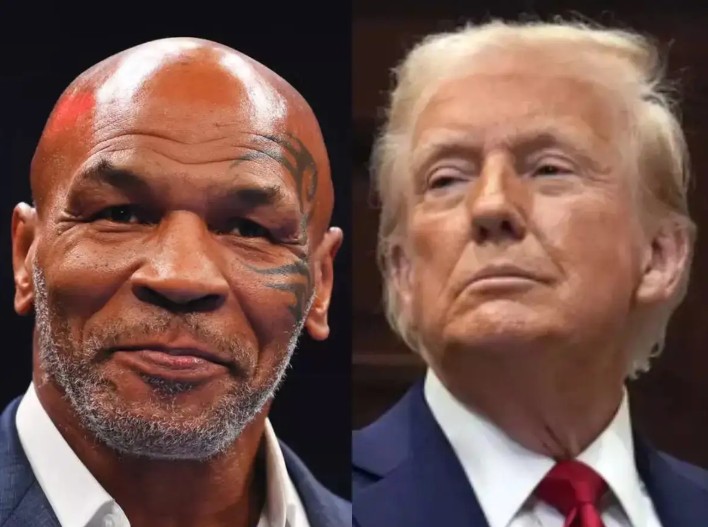
History often remembers alliances at their loudest, but the most enduring bonds are usually formed in silence—long before cameras arrive and long after the crowd disappears. Few people realize that more than 30 years ago, Donald Trump played a decisive role in saving Mike Tyson at a moment when the world was ready to turn its back. And fewer still understand why Tyson would later stand by Trump when doing so carried real personal cost.
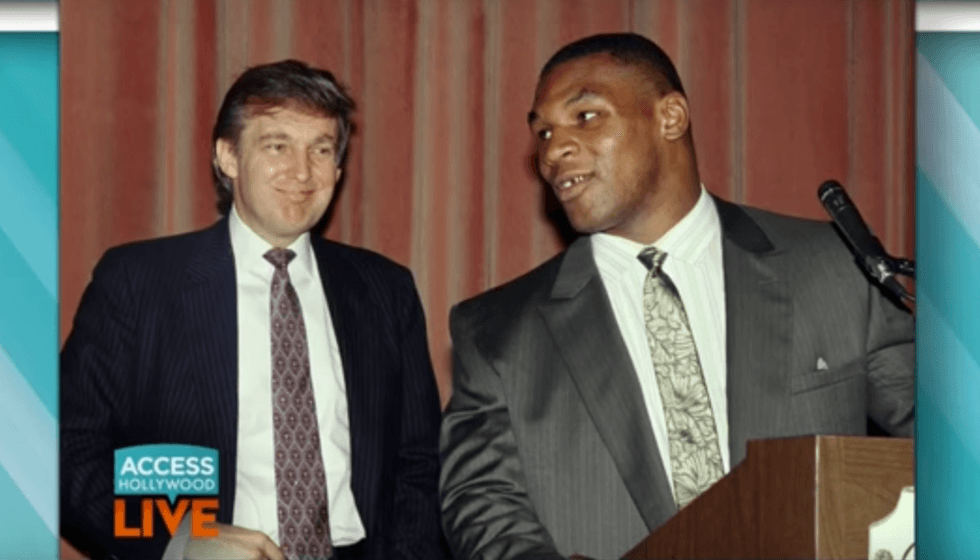
In the late 1980s, Trump was still building his empire, not yet a political figure but an ambitious real-estate magnate searching for attention, legitimacy, and spectacle. He understood something instinctively: boxing wasn’t just sport—it was theater. Blood, power, triumph, downfall. And no stage sold drama like a boxing ring.

Tyson, at the time, was raw talent. Not yet the global phenomenon he would become, but unmistakably dangerous, explosive, and marketable. Where others saw risk, Trump saw potential. He moved quickly, securing the rights to host Tyson’s fights and placing them in his own Atlantic City hotels. It was a gamble—but one that paid off spectacularly.
With Trump’s money, venues, and connections, Tyson’s rise accelerated. His fights became events. His name exploded beyond boxing circles. Trump, in turn, gained national attention, his hotels packed, his brand suddenly associated with dominance and spectacle. It was a symbiotic relationship—two men climbing together, each feeding the other’s ascent.
But friendships forged in success are easy. The real test comes in collapse.
Thirty years ago, Tyson’s life unraveled. Convicted, imprisoned, disgraced, and financially ruined, he emerged from prison to find most doors closed. Sponsors vanished. Friends disappeared. The boxing world moved on. Tyson was no longer a headline—it was a warning label.
Then Trump intervened.

Without press releases. Without contracts. Without conditions.
Trump reportedly gave Tyson $10 million—no repayment demanded, no public acknowledgment required. For Tyson, it wasn’t just money. It was survival. It was dignity at a moment when his name had become shorthand for failure and shame.
For men of a certain generation—those now aged 45 to 65—this detail resonates deeply. Many remember an era when loyalty was measured not by tweets or optics, but by who showed up when everything else fell apart. Tyson never forgot who did.
So when Trump later entered politics and became a lightning rod for controversy, Tyson’s loyalty baffled observers. Critics called it irrational. Cynical. Transactional. But to Tyson, it was neither ideology nor calculation—it was memory.
When everyone else walked away, Trump didn’t.
In interviews, Tyson has never framed the relationship as political. He speaks of it as personal. As debt—not of money, but of life. To him, Trump wasn’t a candidate. He was the man who stepped in when the world had decided he was finished.
That perspective doesn’t require agreement. It requires understanding.
In an age where alliances shift with public opinion and loyalty is often performative, this story cuts against the grain. It reminds us that long before campaigns and courtrooms, relationships are formed in private moments—when there is nothing to gain.
Whether one admires Trump or opposes him, whether one forgives Tyson’s past or condemns it, the bond between them is rooted in something older and harder to erase than politics: gratitude.
And gratitude, once earned at the lowest point of a man’s life, tends to last forever.
That is why, decades later, when Tyson stood by Trump as others turned away, it wasn’t repayment—it was remembrance.
When Silence Turns Into Fire: The Night Jimmy Kimmel Finally Spoke
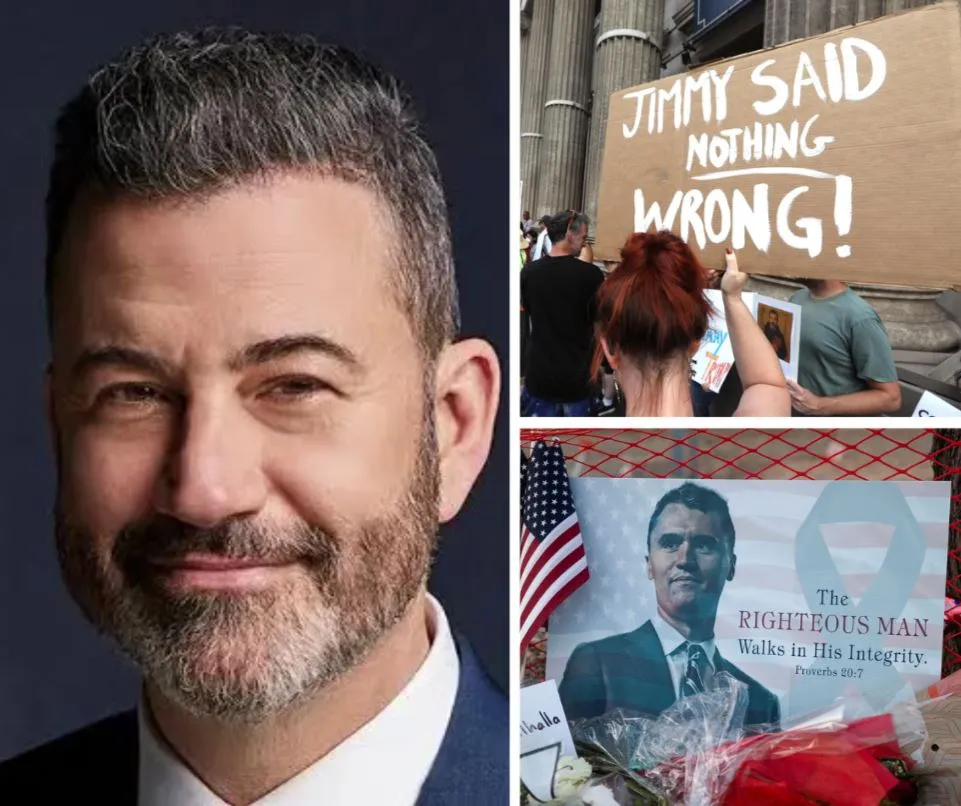
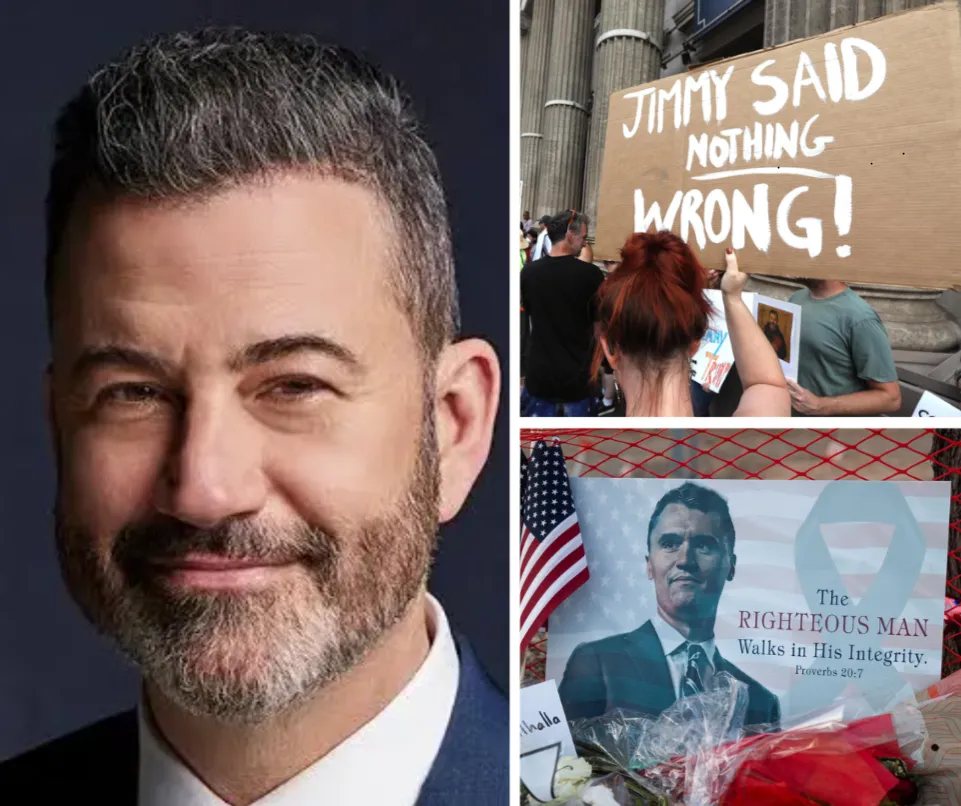
Introduction: The Weight of Silence
Silence is often mistaken for weakness. We assume that when someone chooses not to respond, they are retreating, licking their wounds, or simply too afraid to face the storm. But silence can be something else entirely. It can be strategy. It can be survival. And in rare, unforgettable moments, it can become the kind of pressure that builds and builds until it finally explodes, reshaping everything in its path.
Jimmy Kimmel knows this truth intimately. For months, perhaps years, he carried the burden of words unsaid. He listened to the whispers, the headlines, the casual cruelty dressed up as commentary. He bore the weight of an industry that thrives on humiliation, of audiences that crave vulnerability packaged as entertainment. And he stayed quiet—until he couldn’t anymore.
What followed wasn’t a stumble, wasn’t a miscalculated rant. It was a detonation. A measured, chilling, devastating response that sliced through the room with surgical precision. For those who witnessed it, the memory will never fade.
This is the story of what silence cost him, why he finally broke it, and how his words now echo far beyond the studio walls.
The Build-Up: A Host Under Fire
To understand the gravity of Kimmel’s breaking point, you have to understand the fire he stood in. Jimmy wasn’t just a talk show host anymore; he had become a lightning rod. His monologues—once a mixture of comedy, sarcasm, and heartfelt asides—were dissected under a microscope. A single sentence could fuel days of outrage. A single joke could become evidence in the court of public opinion.
The industry had always been sharp-edged, but in the age of instant virality, the stakes were merciless. Mistakes weren’t forgiven; they were monetized. Misunderstandings weren’t clarified; they were magnified. And when the tide of backlash rose, Jimmy did what few expected—he said nothing.
No tweet. No clarifying statement. No late-night apology disguised as a punchline. Just silence. And in that silence, speculation grew like wildfire. Was he guilty? Was he ashamed? Was he broken? Or was he planning something no one saw coming?
The Breaking Point: A Calculated Strike
The moment arrived not with fireworks but with a kind of unnerving calm. Jimmy’s voice didn’t shake. His eyes didn’t dart nervously. Instead, he leaned into the microphone with a composure that felt almost chilling.
“It wasn’t a misunderstanding. It wasn’t an accident. It was a setup,” he said. Each word fell like a hammer, deliberate and heavy.
And then came the sentence that cracked the air like thunder:
“I don’t flinch. I fire back.”
In that instant, the room changed. It wasn’t a comedian cracking jokes to diffuse tension. It was a man reclaiming his voice, reclaiming his dignity, and reclaiming the narrative that had been written about him in his absence. His silence had been painted as weakness. But his response revealed it for what it truly was: preparation.
The Atmosphere: Shockwaves in the Room
Those who were present describe the moment as surreal. The laughter that usually punctuated his words was gone, replaced by stunned silence. People leaned forward in their seats, eyes wide, as if bracing for aftershocks.
Jimmy didn’t stutter. He didn’t soften the blow. There was no nervous smirk, no attempt to cushion the sharpness. He delivered his words like a marksman pulling the trigger—steady, direct, unflinching.
When he finished, you could almost hear the collective intake of breath. Some were electrified, whispering “finally.” Others were rattled, unsure of what this meant for the carefully choreographed game of television politics. But no one, absolutely no one, walked away untouched.
The Emotional Undercurrent: The Cost of Holding Back
To understand why his words carried such weight, you need to look beneath the surface. This wasn’t simply about reputation. It was about humanity.
Every insult Jimmy had endured, every rumor that twisted his intentions, every smirk from those who thought they’d cornered him—it all added up. Silence had been his shield, but it had also been a prison. Each day of saying nothing meant carrying a heavier load, pretending indifference while his heart absorbed blow after blow.
When he finally spoke, the release wasn’t just for the audience. It was for himself. His voice trembled not with fear, but with the kind of restrained rage that only comes from being underestimated for too long. In his words, there was vindication. There was sorrow. And there was a deep, unmistakable exhaustion.
Why Silence Shatters So Loudly
The reason Jimmy’s words shook the world is simple: silence builds suspense. Every day he didn’t respond, people filled in the blanks with their own narratives. They wrote stories about his cowardice, his arrogance, his downfall. They projected weakness onto him because he refused to give them anything else.
But when silence finally breaks, it does so like glass under pressure—sharp, sudden, and impossible to ignore. His speech wasn’t just a rebuttal; it was the shattering of assumptions, the reversal of power. For the first time in a long time, Jimmy wasn’t the subject of someone else’s story. He was the storyteller.
The Aftermath: Ripples Beyond the Studio
The response spread instantly. Clips of his words flooded social media within minutes. Hashtags trended worldwide. Fans hailed him as brave, while critics scrambled to recalibrate their narratives.
Industry insiders whispered about the shift. Some feared he had burned bridges that couldn’t be rebuilt. Others admired the audacity, secretly envious of the liberation in his defiance. For audiences at home, the moment became more than just late-night television. It became a mirror for their own frustrations, their own silences, their own desire to finally stand up and speak without apology.
Reflections: The Humanity Behind the Spotlight
What’s most striking about Jimmy’s response isn’t its sharpness, but its humanity. Behind the tuxedos, the stage lights, the perfectly timed jokes, there is a man who bleeds like anyone else. A man who had grown tired of being caricatured, misinterpreted, and used as fodder for other people’s narratives.
His decision to fire back wasn’t about ego. It was about reclaiming personhood. About reminding the world that even those in the public eye deserve the dignity of truth. About proving that silence, while powerful, does not mean submission.
The Larger Lesson: Why We All Break Eventually
Jimmy Kimmel’s breaking point is a universal story. We’ve all been there, in smaller ways. We’ve all bitten our tongues while someone misrepresented us. We’ve all endured moments where the weight of staying silent threatened to crush us. And we’ve all fantasized about the day we finally let go, finally spoke our truth, finally shattered the suffocating quiet.
His story reminds us that breaking silence is never just about words. It’s about reclaiming identity. It’s about refusing to be defined by others. It’s about choosing the risk of speaking over the poison of suppressing.
Conclusion: The Fire That Burns After Silence
In the end, Jimmy Kimmel’s outburst wasn’t really an outburst at all. It was a release, a liberation, a necessary fire. And like any fire, it scorched. It scared. It illuminated.
Those who heard his words will remember them not because they were perfectly polished, but because they were raw. They came from a man who had reached his limit, a man who had been silent too long, and a man who finally chose to remind the world that he could still strike back.
For Jimmy, silence is no longer an option. And for the rest of us, maybe that’s the lesson: when the moment comes to reclaim our voice, hesitation has no place. Because silence may protect us for a while—but only fire can set us free.

